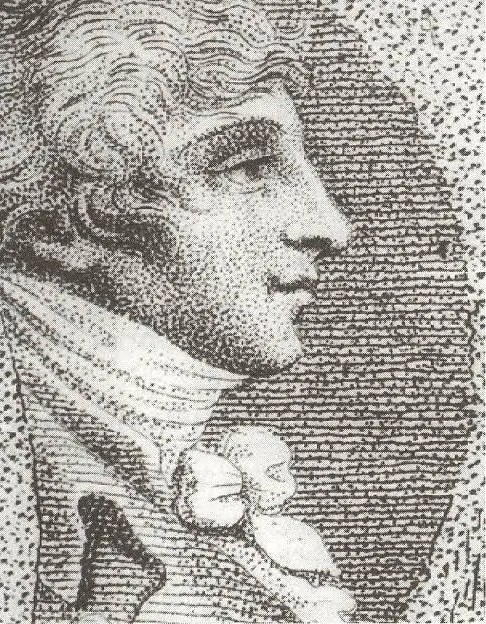
Feliks Janiewicz
(1762–1848)
Educational Travels and Continental Success
Thanks to King Stanisław August Poniatowski, who funded his educational trip abroad Janiewicz embarked on a series of journeys. His first stop was France (1784), likely Nancy. The choice of this city, although not a major music centre, might have stemmed from the warm relations between Lorraine (the duchy of Stanisław Leszczyński and a Poniatowski residence) and the Polish-Lithuanian Commonwealth. Mieczysław Szlezer suggests that Janiewicz studied with Joseph-Barnaby Saint-Sevin, a respected pedagogue and founder of the French school of violinism, which emphasized virtuosity and technical proficiency.
In February 1785, Janiewicz made his debut in Vienna at the Burgtheater, where his virtuosity quickly won the appreciation of both the public and the musical community. He enjoyed the favour of Joseph Haydn and Wolfgang Amadeus Mozart. Opinions exist that Mozart dedicated the Andante for violin and orchestra (KV 470) to Janiewicz, which is the second version of the second movement of the Violin Concerto in D major (KV 218), and that the Polish violinist was intended to be its first performer. In Vienna, Janiewicz was also acquainted with the Polish violinists, the brothers Jan Baptysta and Franciszek Kleczyński. Michael Kelly, an Irish tenor and friend of Mozart living in Vienna, recalled Janiewicz as one of the world’s finest violinists, highlighting the unforgettable sound of his instrument and his compositional talent, especially for the Polonaises and Variations with which he typically concluded his concerts.
In 1786, Janiewicz travelled to Italy, where his career as a soloist truly flourished. Owing to the impeccable manners acquired at the royal court and his proficiency in foreign languages, he easily charmed the powerful in the salons he visited. After one concert, he met Princess Izabela Lubomirska, who financed his further stay and lessons with Pietro Nardini and Gaetano Pugnani (1786–1787). In Naples, despite the moderate interest in violinists, he earned substantial sums, higher than those of other musicians and even the highly valued singers of the evening.
From Italy, Janiewicz moved to Paris, performing, among other venues, at the Concerts de la Loge Olympique and sharing the stage with Jean-Jérôme Imbault, who later published his works. From 1790, he was a member of the orchestra of the Duke of Orléans, Louis Philippe Joseph.
Activity in Great Britain and Legacy
Following the outbreak of the French Revolution in 1792, Feliks Janiewicz departed for the Kingdom of Great Britain at the invitation of the impresario Johann Peter Salomon. He quickly adapted to British concert life, earning critics’ praise for “a certain sustained tone of bow stroke” and his beautiful blend of “simplicity and passion.” He frequently performed with Haydn in the Hanover Square Rooms. While in England, Janiewicz also met the twelve-year-old Black violinist of Polish origin, George Augustus Polgreen Bridgetower.
In October 1799, Janiewicz married Eliza Breeze, and they settled in Liverpool, where they spent 15 years. Janiewicz not only conducted the orchestra and organized his own concert series but also became a businessman. In 1801, he founded the shop Music, Musical Instruments Warehouse, selling instruments and printed music, including his own miniatures and transcriptions of opera arias. He performed in nearly all major venues across Great Britain, collaborating with figures such as the famous Italian singer Angelica Catalani.
In 1813, Janiewicz was among the 30 founders of the Philharmonic Society of London (now the Royal Philharmonic Society), an association established to promote instrumental music concerts and commission new repertoire (including Beethoven’s Ninth Symphony).
In 1815, he moved to Edinburgh, where he co-organized the first Edinburgh Festivals (1815, 1819, 1824). He was a pioneer, focusing on instrumental music and promoting concert programmes primarily by composers’ names, which was innovative for the time. These festivals are considered the inspiration for the later Edinburgh International Festivaland the Edinburgh Festival Fringe.
Janiewicz played his farewell concert in 1831. Around the same time, Niccolò Paganini visited him, addressing the ageing violinist as “Mój Mistrzu” (My Master). Janiewicz and Eliza raised three talented children: the pianist and singer Felicja, the harpist Paulina, and the surgeon Felix Junior, who was the first doctor in Great Britain to perform surgery under general anaesthesia (using ether). Feliks Janiewicz died on May 21, 1848, in Edinburgh