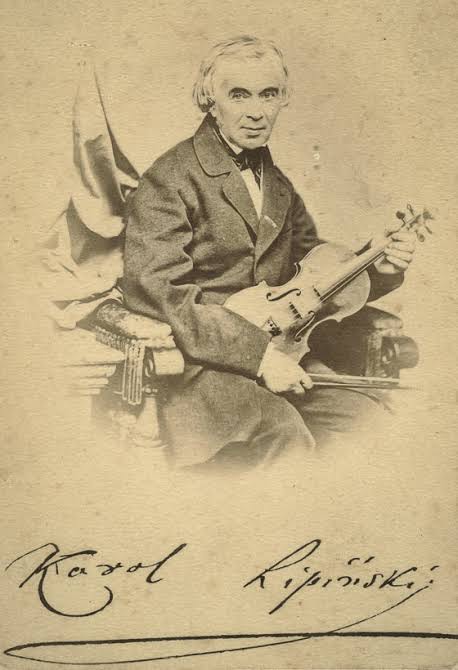
Karol Lipiński
(1790-1861)
Karol Lipiński, a violinist, composer, and conductor, was born on October 30, 1790, in Radzyń in Podlasie, and died on December 16, 1861, in Urłów near Lviv.
He began learning to play the violin exceptionally early—at the age of five, under the tutelage of his own father. In 1799, he moved with his family to Lviv. There, he took on the role of concertmaster in the palace orchestra of Count Adam Starzeński, which his father conducted. Interestingly, Lipiński quickly mastered the cello as well, achieving an equally high standard. His career in Lviv developed dynamically: in 1809, he became the concertmaster, and in 1811, he was promoted to bandmaster (Kapellmeister) of the opera theatre orchestra.
In 1814, Lipiński traveled to Vienna, where he met the famous German violinist and composer, Louis Spohr. It was Spohr who convinced him to abandon his work at the Lviv theatre and dedicate himself exclusively to a career as a violin virtuoso. Lipiński focused on perfecting his technique and preparing a professional repertoire.
In 1817, after a performance in Lviv, Lipiński embarked on a long artistic journey to Italy. He gave successful concerts in Venice, Milan, and other cities. The most important event was his two joint appearances with Niccolò Paganini in Piacenza in April 1818.
In the following years, Lipiński went on a multi-year tour, garnering great applause in cities such as Kyiv, Vilnius, Kraków, Wrocław, Leipzig, Berlin, Moscow, and St. Petersburg. His performances in Warsaw at the turn of 1827 and 1828 resulted in his nomination as First Violinist of the Court of the Kingdom of Poland, and in 1831—of the Imperial (Tsar’s) Court. In May 1829, in Warsaw, he had the opportunity to play with Paganini again during the coronation ceremonies of Tsar Nicholas I.
In 1830, Lipiński took a three-year break from performing to fully devote himself to further perfecting his playing. He later resumed his travels across Europe, performing in Paris (where he received assistance with concert organization from Fryderyk Chopin), London, Manchester, and Frankfurt am Main, among others. Following his concerts in Vienna, in recognition of his masterful playing, he received the title of honorary citizen of that city.
In 1839, Lipiński settled permanently in Dresden. For twenty years, he held the prestigious position of Concertmaster of the Royal Saxon King Frederick Augustus’s orchestra. In addition, he participated in numerous chamber and symphony concerts (including playing with Franz Liszt) and traveled to Lviv, Kyiv, and Warsaw. Simultaneously, he was involved in pedagogical work, mentoring, among others, 14-year-old József Joachim (in 1845) and 13-year-old Henryk Wieniawski (in 1848).
Unfortunately, from 1846, rheumatic disease forced him to gradually limit his concert activity. For his outstanding services to the royal court, he was awarded the Knight’s Order of Prince Albert in 1854. In 1861, he retired and moved to his estate in Urłów near Lviv, where he founded a music school for talented peasant children.