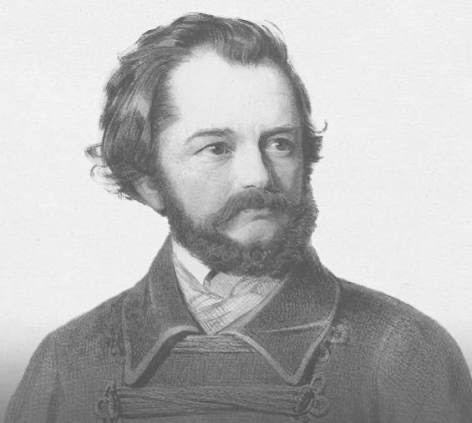
Feliks Ignacy Dobrzyński (1807–1867)
Feliks Ignacy Dobrzyński — an eminent composer, conductor, pianist, and educator — was born on February 25, 1807, in Romanów, Volhynia. His life ended in Warsaw, where he died on October 9, 1867.
Education and Early Career
His education began at the Jesuit college in Romanów. Subsequently, between 1817 and 1821, he attended school in Vinnytsia, where he graduated from the Podolian Gymnasium.
He initially received musical instruction from his father, Ignacy, who was himself a violinist, composer, and conductor. From 1825, he studied in Warsaw under the direction of the famous Józef Elsner, initially privately. Between 1826 and 1828, he continued his education at the Main School of Music in Warsaw.
He began composing while still in Vinnytsia. After settling permanently in Warsaw, he pursued a very lively career as a composer and educator, organizing musical ensembles, advocating for the staging of symphonic concerts, and frequently appearing as a conductor at these events.
Major Achievements
He earned considerable recognition as a piano teacher. The result of this pedagogical work was the publication of the textbook ” Piano School” (Szkoła na fortepian) in 1845 by the Sennewald publishing house in Warsaw.
In 1835, he achieved a significant success by winning the 2nd prize at a composition competition in Vienna for his 2nd Symphony in C minor, Op. 15. Fragments of this Symphony were later performed in Warsaw, as well as in Leipzig, where it was conducted by Felix Mendelssohn-Bartholdy.
In 1862, it was published in Warsaw by Sennewald in a four-hand arrangement under the title Characteristic Symphony in the Spirit of Polish Music.
Between 1836 and 1838, he composed his first opera, Monbar, or The Filibusters (Monbar czyli Flibustierowie), Op. 30. Fragments of the work were performed in concerts in Warsaw, Poznań, Berlin, and Dresden. The stage premiere of the opera took place at the Grand Theatre in Warsaw (Teatr Wielki) in 1863.
Travels and Further Activity
Between 1841 and 1843, he taught music at the Aleksandrian Institute for the Education of Maidens. In March 1845, he embarked on an artistic journey across Europe, visiting Berlin, Leipzig, Dresden, Munich, Bonn, Frankfurt am Main, and Vienna, where he presented his own compositions.
He was forced to stay longer in Berlin, earning a living by giving music lessons. His return to Poland was delayed because he had composed several patriotic works, including the song To a Polish Mother (Do matki Polki), with words by Adam Mickiewicz. He only returned to Warsaw in September 1847.
In 1852, he was hired as a conductor of the opera at the Grand Theatre, but he held this position for less than a year. In the following years, he limited himself to conducting the opera orchestra at symphonic concerts, which took place, among other venues, in the halls of the Merchants’ Assembly (Resursa Kupiecka).
Organizing Musical Life and Final Years
In October 1857, he organized the Ignacy Feliks Dobrzyński Polish Orchestra, composed of outstanding members of the Grand Theatre orchestra. This orchestra gave weekly concerts in New Arcadia on Mokotowska Street until December 1857.
Between 1858 and 1860, he was involved in the work of the committee established to found the Musical Institute in Warsaw. During this period, he also became a member of the Lwów Musical Society.
After 1860, due to poor health, he gradually withdrew from active participation in the capital’s musical life and dedicated himself exclusively to composition.